
Streptokinase
Rx
Generic NameStreptokinase
Therapeutic ClassThrombolytic (Fibrinolytic)
Dosage FormInjection (IV infusion)
PregnancyUse only if clearly needed
Indications ▼
Acute ST-Elevation Myocardial Infarction (STEMI): To dissolve coronary thrombus and restore myocardial perfusion when primary PCI is not available.
Pulmonary Embolism (Massive or Submassive): For rapid thrombus dissolution in hemodynamically unstable patients.
Deep Vein Thrombosis (DVT): In selected cases to prevent post-thrombotic complications.
Peripheral Arterial Thrombosis/Embolism: To restore arterial blood flow in acute limb ischemia.
Mechanism & Pharmacokinetics ▼
Mechanism: Forms a complex with plasminogen, converting it into plasmin, which degrades fibrin clots and fibrinogen, leading to thrombus dissolution.
Pharmacokinetics: Administered intravenously. Rapid onset of fibrinolytic action. Half-life approximately 20–30 minutes. Cleared via reticuloendothelial system.
Dosage & Administration ▼
| Indication | Dose | Administration |
|---|---|---|
| Acute MI | 1.5 million IU | IV infusion over 60 minutes |
| Pulmonary Embolism | 250,000 IU loading, then 100,000 IU/hour | Continuous IV infusion for 24 hours |
| DVT | 250,000 IU loading, then 100,000 IU/hour | Continuous IV infusion for 72 hours (as directed) |
Note: Administer under strict hospital supervision with monitoring of coagulation parameters and bleeding signs.
Side Effects ▼
Bleeding (major risk)
Hypotension
Allergic reactions (fever, rash)
Anaphylaxis (rare)
Intracranial hemorrhage (rare but serious)
Contraindications ▼
Active internal bleeding
History of hemorrhagic stroke
Recent major surgery or trauma
Severe uncontrolled hypertension
Known hypersensitivity to streptokinase
Drug Interaction ▼
Anticoagulants (heparin, warfarin): increased bleeding risk
Antiplatelet agents (aspirin, clopidogrel): additive bleeding risk
NSAIDs: increased gastrointestinal bleeding risk
Pregnancy & Lactation ▼
Use during pregnancy only if potential benefit justifies risk due to bleeding possibility.
Breastfeeding: Caution advised; limited data available.
Clinical / Research Summary ▼
Clinical Role: Cost-effective thrombolytic agent for acute MI and major thromboembolic events when PCI is unavailable.
Advantage: Widely available and affordable in resource-limited settings.
Limitation: Higher risk of allergic reactions and bleeding compared to newer fibrinolytics.
Monitoring: Blood pressure, coagulation profile, signs of internal or external bleeding.
Patient Counseling Points ▼
Administered in hospital setting only.
Report any unusual bleeding, severe headache, or weakness immediately.
Avoid trauma or invasive procedures during treatment.
Storage & Handling ▼
Store refrigerated at 2–8°C.
Protect from light.
Use reconstituted solution immediately.
Brand Names (Bangladesh & Global) ▼
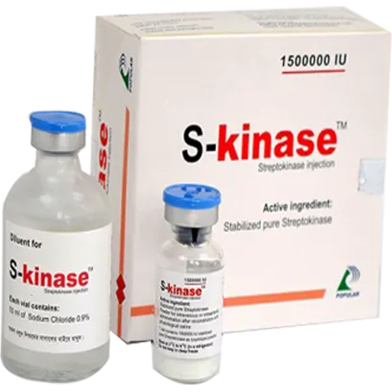 S-Kinase® 1.5 million IU
Medical Disclaimer: For educational purposes only. Not a substitute for professional medical advice.


